
Dabba Trading in India: How It Works, Risks, Regulations & Legal Alternatives

Dabba Trading in India

Interest in Dabba Trading in India has increased as more people search online for low-cost trading and high-margin opportunities. The terminology can be confusing because some unregistered operators use websites, apps and trading-style dashboards that resemble legitimate broker platforms. Understanding what happens behind the interface is therefore more important than judging a service by its appearance.

What Does Dabba Trading Mean?

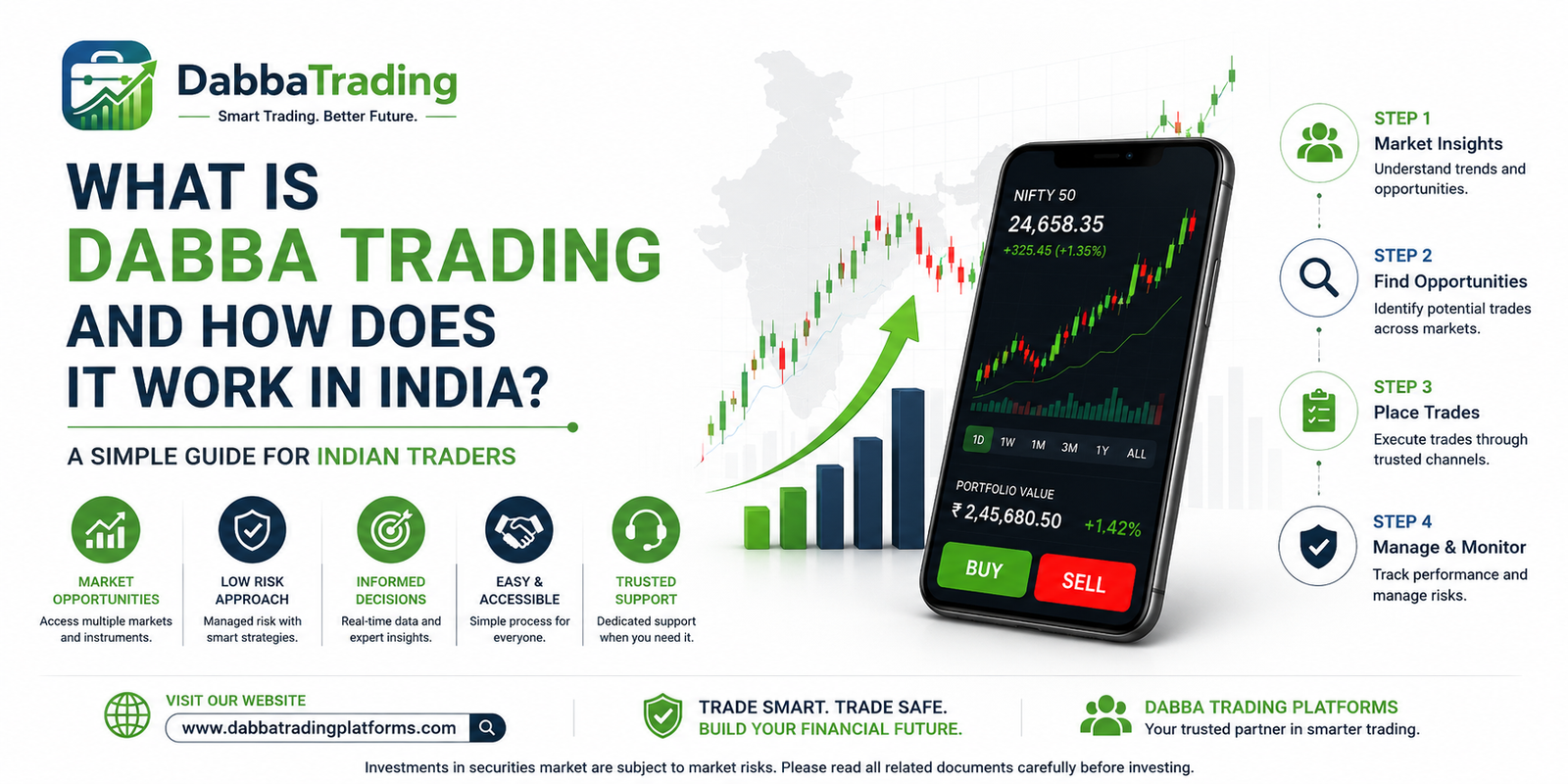
Dabba trading refers to an arrangement where transactions are not actually executed on a recognised stock exchange. Instead, the operator records the customer’s positions internally and settles gains or losses directly with that customer.

SEBI identifies dabba trading as an illegal and unregulated form of securities trading. Because the trade does not take place on an official exchange, the participant does not receive the normal exchange-based grievance-redressal framework.

How the Arrangement Typically Works

A customer may contact an operator through a website, phone number, messaging service or application. After opening an informal account, the customer is shown prices and may be allowed to place buy or sell instructions.

The crucial difference is what happens after the instruction is placed. In a regulated transaction, the order goes through the authorised market infrastructure and creates an exchange-recognised trade. In a dabba arrangement, the operator may simply enter the position in an internal record.

The customer’s profit or loss is subsequently calculated according to the referenced market price. This means the operator effectively stands between the customer and the settlement of the position.

Why High Margin Can Be Dangerous

Margin is commonly highlighted in promotions for unregistered trading services. A customer may be told that a small deposit can support a much larger position. Although this can increase potential gains, it also magnifies potential losses.

For example, if a trader controls a position several times larger than the deposited amount, even a relatively modest adverse price movement can consume a substantial portion of the available margin. Extremely high leverage can make this effect even stronger.

Margin should therefore never be viewed as free buying power. It is simply a mechanism that increases exposure relative to capital.

Regulatory Concerns

The main regulatory issue is that dabba transactions occur outside the recognised exchange framework. SEBI warns that participants cannot rely on the usual exchange grievance mechanism for such trades.

This also affects transparency. A customer may have a statement or dashboard showing positions, but an internal statement is not the same as an exchange-generated record of an executed trade.

Counterparty and Settlement Risk

In a regulated market, several layers of infrastructure support order execution, clearing and settlement. In a dabba arrangement, the customer may depend almost entirely on the operator.

This creates counterparty risk. If an operator refuses to honour a payout, disappears, blocks an account or changes settlement terms, the customer may have limited practical options.

Settlement claims should therefore be examined carefully. Fast payouts and informal promises are not substitutes for a regulated settlement system.

Legal Alternatives for Traders

People who want to trade Indian securities should use authorised brokers and recognised exchanges. A Legitimate Trading Account normally provides documented orders and transactions, contract notes, defined charges and access to established investor grievance procedures.

Before selecting a broker, investors should verify its regulatory status independently. They should also avoid making decisions based solely on social-media recommendations, referral offers or claims of guaranteed returns.

Questions to Ask Before Opening a Trading Account

Is the intermediary properly registered? Where will my orders actually be executed? Will I receive official trade records and contract notes? What are the charges? What grievance mechanism is available if something goes wrong? Are the advertised returns realistic?

These questions can help distinguish a regulated service from an informal trading arrangement.

Conclusion

Dabba trading may look similar to ordinary online trading, but the underlying structure is fundamentally different. The combination of off-exchange execution, counterparty dependence, high leverage and limited investor protection can make the model particularly risky.

For anyone researching Dabba Trading Platforms in India, the safest approach is to understand the regulatory status first and consider regulated market alternatives instead of focusing only on margin, speed or promotional offers.

Regulatory reference: SEBI Investor guidance on Dabba Trading.

Leave a Reply

Your email address will not be published. Required fields are marked *

Related Post

  • dabbatradingplatforms

    Why Traders Searching for High-Leverage Platforms Are Fueling a New Online Trend in India

    Online Trend in India:- Open any trading community on Telegram, scroll through a stock market forum, or look at search trends across India right now, and you will see the same pattern repeating itself. Traders — young and experienced alike — are actively searching for high-leverage platforms. Not just platforms with slightly more margin than… Know More

  • Informa Trading Networks

    Why Thousands of Young Traders Are Rushing to High-Risk Informal Trading Networks

    Informa Trading Networks Something big is happening in India’s trading landscape. On any college campus, co-working space or social media trading community, you will find a new generation of young traders, confident digital natives, and increasingly drawn to informal trading networks that exist outside the traditional financial system. It’s not an outlier issue. It’s a… Know More

  • No. 1 Trading Site in India

    What Makes the No. 1 Trading Site in India Stand Out?

    Finding the No. 1 Trading Site in India is really important for anyone who wants to trade safely. The financial markets are always changing so traders need a platform that can do things quickly has tools and gives them the latest market information. They also need to know that they can get help when they… Know More

  • DABBA TRADING

    What Is Dabba Trading and How Does It Work in India?

    DABBA TRADING refers to an unauthorized form of trading in which transactions are conducted outside the recognized stock-exchange system. Instead of the investor’s order being executed and settled through a regulated exchange, the operator records the transaction in its own books. Basically, the price can be related to the movements in stocks, indices, commodities, or… Know More

  • Best Online Dabba Trading in India

    What Features Make the Best Online Dabba Trading in India?

    People are really getting into Dabba Trading these days because they want to try out ways to be a part of the financial markets. Now we have trading platforms that make it easy to trade. These platforms are fast easy to use. You can access them from anywhere which makes trading a lot simpler. When… Know More

  • Online Trading in India

    What Are the Benefits of Online Trading in India?

    Online trading in India has become very popular. More traders are looking for fast ways to trade in financial markets. With more people having internet and mobile phones many are searching for platforms that’re easy to use and have good customer support. If you are looking into trading in India it helps to know how… Know More

  • Trusted Dabba Trading in India

    Trusted Dabba Trading in India: Complete Guide to the Right Trading Platform

    There have been many developments in terms of the involvement of participants in the Indian financial market through equities, commodities, and derivatives. Besides the traditional stockbroking firms and trading platforms, off-market trading networks, also called Dabba Trading, still remain attractive to investors who seek settlement outside conventional means, high leverage, and lower statutory charges. Finding… Know More

  • dabba trading

    Trading Forex, Crypto, and Commodities on Dabba Trading Platforms

    Dabba Trading platforms:- Today’s financial landscape is no longer confined to the four walls of a traditional stock exchange. Modern traders are more focused and are seeking flexibility, higher leverage, and lower overhead costs. It is where the concept of the Dabba Trading platforms has re-emerged as a powerful alternative. Those looking to maximize their capital… Know More

  • Top Day trading platfroms in India

    Top Day Trading Platforms in India with Quick Execution and Sophisticated Market Tools

    Top Day trading platfroms in India has never been more competitive – or more lucrative if you do it right. With millions of retail traders now participating in Indian equity and derivatives markets in every single session, the advantage that makes the difference between consistently profitable traders and the rest is down to two things… Know More

  • top dabba trading platform in india

    Top Dabba Trading Platform in India: What Traders Need to Know

    Finding a best dabba trading website in India is a growing trend amongst people who seek rapid app-based dabba trading access in connection with the market. Advertisements, ease in opening accounts, low-cost deals, and promise of fast earnings make them tempting options for individuals. But one should know about an essential difference before deciding on… Know More