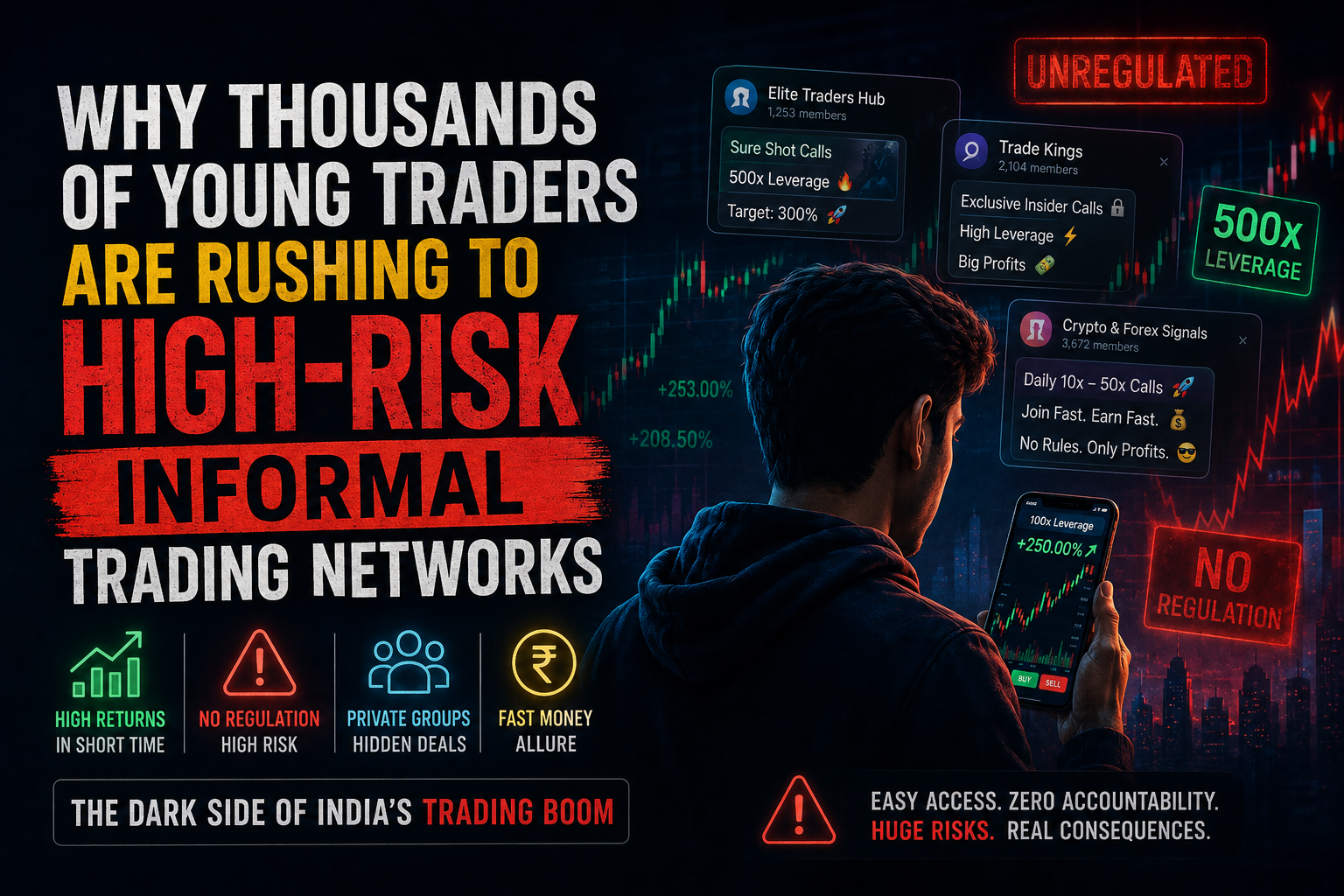




Finding a best dabba trading website in India is a growing trend amongst people who seek rapid app-based dabba trading access in connection with the market. Advertisements, ease in opening accounts, low-cost deals, and promise of fast earnings make them tempting options for individuals.
But one should know about an essential difference before deciding on dabba trading in India: dabba trading is something completely different from legal stock exchange trading.
According to the Securities and Exchange Board of India (SEBI), dabba trading is an illegal and unregulated activity related to securities trading.
Transactions are not carried out on the recognized SEBI stock exchanges but are settled inside the dabba operator’s office.
That means searching for a Trusted Dabba Trading Platform in India should begin with regulatory awareness rather than promotional claims.
What Is Dabba Trading?
Dabba trading is an off-exchange arrangement where trades are recorded and settled by an operator rather than being executed through a recognised stock exchange.
The activity may imitate conventional stock-market trading because users can receive prices, place buy or sell instructions, and see apparent profits or losses. The critical difference is where the transaction is actually executed.
The SEBI says dabba trading happens away from the official stock exchange platform and any regulation. So, there are no grievance-redressal procedures available for investors on such platforms.
Is There a Top Dabba Trading Platform in India?
There is no “top” dabba trading platform in India because dabba trading is itself unauthorised.
It is not enough for a trading platform to be professional-looking or have some good reviews to qualify as authorised.
Traders need to ask themselves:
- Who runs the platform?
- Is the intermediary regulated by the relevant regulator?
- Where do the trades get executed?
- Are there transparent trade records?
- Is there a recognised grievance-redressal procedure?
- Do the claims of the platform stand up to independent verification?
SEBI maintains a database of recognised intermediaries where investors can check registration information.
Why Do Traders Search for a Trusted Dabba Trading Platform in India?
Several factors may contribute to interest in dabba trading, particularly among inexperienced traders:
Attractive Pricing Claims
Some unregulated operators may promote unusually low brokerage, commissions, or other charges. Lower advertised costs, however, do not compensate for the lack of regulatory protection.
Quick Account Opening
The application might claim easy registration with little paperwork. While it may sound convenient, financial service applications need to identify, verify and comply with the right processes.
Profit-driven Advertisements
Promises of fast or guaranteed profits can attract inexperienced users. Investors should remember that genuine market trading involves risk and that no legitimate market strategy can eliminate that risk completely.
Social-Media Promotion
Trading platforms can be promoted through social-media pages, messaging groups, influencers, and referral networks. Popularity on social media should never be treated as evidence of regulatory approval.
Major Risks of Dabba Trading
1. No Recognised Exchange Protection
SEBI explains that dabba transactions are not executed on official recognised stock exchanges. Investors therefore do not receive the same exchange-based protections and grievance mechanisms.
2. Operator and Settlement Risk
Because transactions are handled internally by the operator, users can face significant uncertainty regarding settlement and recovery of funds if a dispute occurs.
3. Lack of Regulatory Oversight
An unregulated platform does not provide the same regulatory framework as an appropriately registered intermediary operating within recognised market infrastructure.
4. Withdrawal and Dispute Problems
If a user experiences a withdrawal problem or disagreement over an internally recorded transaction, resolving the issue may be considerably more difficult.
5. Personal-Information Risks
Unverified applications and websites can ask for personal information. The investor must never share their password, OTP, PIN or any other private information with strangers or the platform.
SEBI specifically suggests investors refrain from getting involved with unregistered brokers and intermediaries, and also avoid dabba trading.
How to Know If a Trading Platform is Reputable
People searching for a Trusted Dabba Trading Platform in India should instead use a verification-first approach when evaluating any legitimate trading service:
Check Regulatory Registration
Do not rely on a platform’s own statement that it is “registered” or “approved.” Independently verify the relevant intermediary through official regulatory resources.
SEBI’s recognised-intermediary database allows users to search registered intermediaries and relevant registration information.
Understand Where Trades Are Executed
Ask whether transactions are actually executed through the appropriate recognised exchange and market infrastructure:
Review Fees and Terms
Read brokerage, transaction charges, withdrawal conditions, account terms, and other applicable disclosures before using a financial service.
Avoid Guaranteed Returns
Claims such as “fixed daily profit,” “guaranteed income,” or “zero-risk trading” should immediately raise concerns.
Protect Your Account
Never share passwords or other confidential online-account credentials. SEBI’s investor guidance specifically advises investors not to share online account passwords.
What Is the Safer Alternative?
Rather than searching for a top dabba trading platform in India, investors interested in legitimate market participation should research properly regulated financial intermediaries.
The recognised intermediary database maintained by SEBI presently consists of thousands of registered stockbrokers in various market categories, and hence provides a reliable starting point for investors wishing to verify these intermediaries.
The aim here is to look for a service that will ensure regulatory approval, documentation, market access, due KYC process, and effective grievance redressal mechanism.
Key Takeaways
- Dabba trading is illegal and unregulated in India.
- There is no legitimate “top dabba trading platform” that should be recommended.
- Dabba transactions are not actually executed on official SEBI-recognised stock exchanges.
- Users may lack normal exchange-based grievance-redressal mechanisms.
- A professional-looking app does not prove regulatory legitimacy.
- Investors should independently verify financial intermediaries.
- Avoid guaranteed-profit and unrealistic-return claims.
- Never share passwords, OTPs, PINs, or confidential account information.
- Use official regulatory resources when checking a trading intermediary.
- Consider legitimate, regulated market channels instead of dabba arrangements.
Final Thoughts: Verify First, Trade Smarter
Even though the expression “top dabba trading platform in India” could entice those who are looking for quick trading facilities, what matters more is not the beauty or the promotion of an application.
Dabba trading is unauthorised and unregulated. It is recommended by SEBI that you should not indulge in dabba trading.
As far as Indian traders are concerned, what they need to do is check the intermediary, know about the places where trading takes place, get knowledge of the relevant laws and safeguard their credentials.
Dabba Trading Platforms could be considered as an informative source, where the reader learns about the difference between convenience of trading and regulatory safety.
Frequently Asked Questions on Dabba Trading Platforms in India
What is a dabba trading platform?
A dabba trading platform assists in the off-exchange process, whereby there is internal recording and settlement of trades rather than actual trades taking place on a recognized stock exchange. According to SEBI, dabba trading is an illegal process.
Is it possible to get a reliable dabba trading platform in India?
There is no dabba trading for investors. They need to ensure the financial intermediary they are using is properly licensed and that the transactions are made through recognized market infrastructures.
Why is dabba trading regarded as a risky process?
This is because dabba trading takes place outside recognized stock exchanges and regulatory process. This exposes the parties involved to various kinds of risks.
How do I confirm a trading platform?
The investor needs to check if the platform is properly licensed by independent means. The SEBI provides a database of recognized financial intermediaries.
Is it possible to have guaranteed profit from trading?
No. Financial markets trading always have risks associated with it. The guaranteed profits are a serious red flag.